ATB Market is Ukraine’s largest supermarket chain and operates a large-scale e-commerce platform with significant organic search visibility.
I worked with the project as an SEO Specialist at a marketing company, contributing to its SEO strategy, technical optimization, semantic expansion, content development, link-building planning, and ongoing performance analysis.
The results presented in this case reflect the period during which I was directly involved in the project.
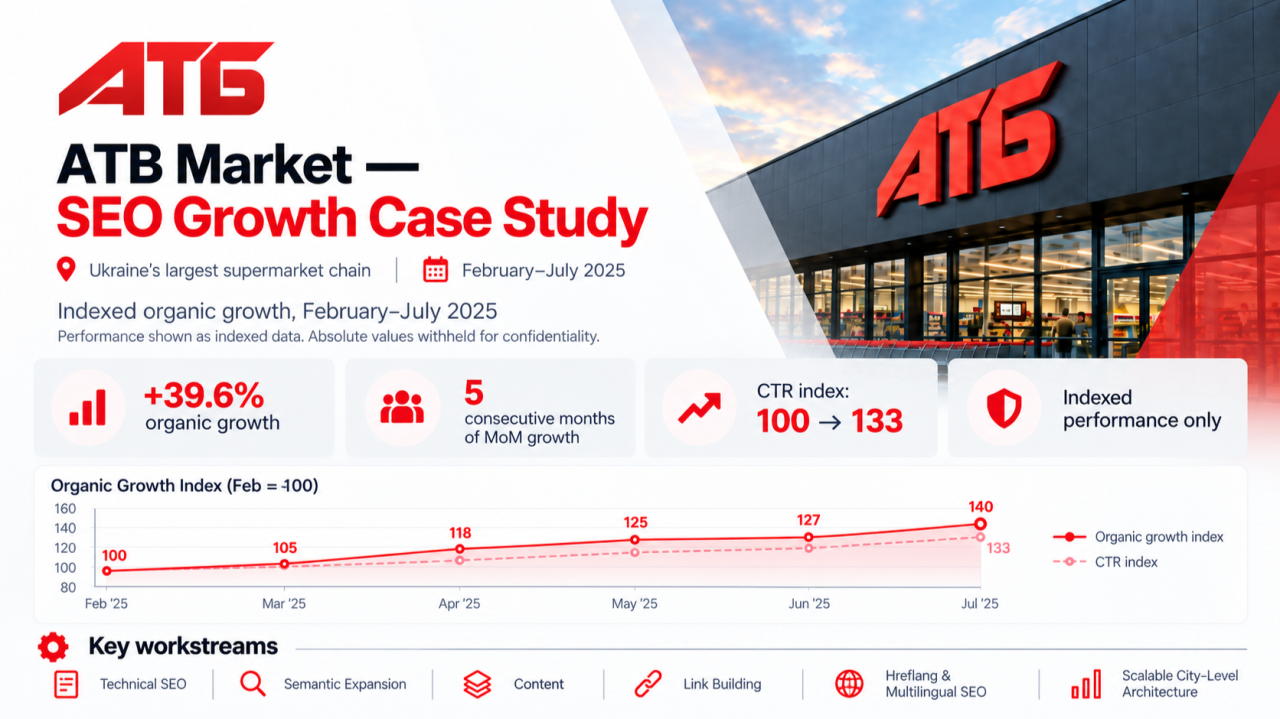
Over five months, the project achieved:
- +39.6% organic traffic growth
- Five consecutive months of month-over-month growth
- ~32.5% improvement in organic CTR
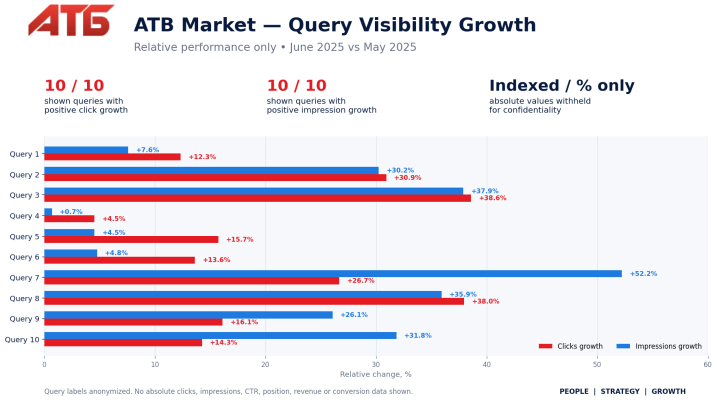
- Stronger visibility across priority search queries
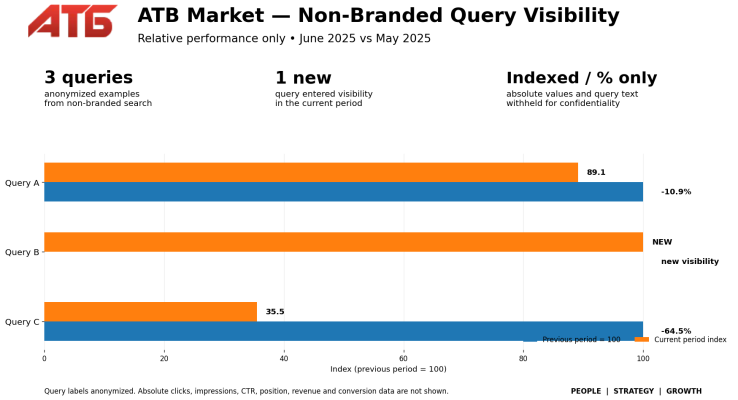
- Early growth in non-branded product visibility
The result came from systematic work across technical SEO, semantic expansion, content, link building, multilingual search visibility, and preparation for local SEO scaling.
Project Overview
Project: ATB Market Market: Ukraine Period: February–September 2025 My role: SEO Specialist at a marketing company Website type: Large-scale e-commerce / grocery retail
During my time working with the project, my responsibilities included SEO analysis, strategy development, technical SEO, semantics, content optimization, competitor analysis, link-building planning, and monitoring implementation and performance.
The results below represent the SEO performance achieved during this period of my involvement with the project.
The main objectives were to:
- remove technical limitations affecting crawling and indexation;
- improve organic visibility beyond branded queries;
- expand category and product semantics;
- improve search-result click-through performance;
- strengthen content and authority signals;
- prepare the website for scalable geographic growth.
Starting Point
The website already had strong organic visibility, but a significant share of traffic was concentrated around branded searches and promotional pages.
At the same time, category-level and non-branded product semantics still had substantial room for growth.
The initial technical audit also identified several areas that could limit further performance:
- site mirrors without a unified redirect strategy;
- duplicate pages;
- 404 errors and broken links;
- duplicate or missing H1 headings;
- canonicalization issues;
- limited accessibility of some filters for search crawlers;
- unresolved multilingual search requirements.
The SEO Strategy
The work was divided into five main areas:
1. Technical SEO 2. Semantics and content 3. Link building 4. Multilingual search visibility 5. Local SEO architecture
1. Technical SEO Foundation
The project started with a comprehensive technical SEO audit and prioritization of issues according to their potential impact.
Technical SEO then became an ongoing process rather than a one-time audit.
Regular crawling and implementation monitoring were conducted together with the development team.
The technical roadmap covered:
- canonicalization;
- redirects;
- duplicate-page issues;
- broken links and 404 errors;
- search crawler accessibility of filters;
- internal crawl paths;
- multilingual URL handling;
- HTML sitemap improvements;
- selected UX issues affecting the website.
The focus was not only on identifying problems, but also on ensuring that recommendations were implemented and monitored consistently.
2. Semantics and Content
The second major direction was expanding semantic coverage.
Keyword research covered:
- commercial categories;
- brands;
- product-related demand;
- informational topics.
Google Search Console and Serpstat data were used to prioritize areas with the strongest growth potential.
The work included:
- semantic research and clustering;
- expansion of priority categories;
- metadata optimization;
- H1 optimization;
- content production;
- E-E-A-T improvements.
Content production was scaled across key categories to increase the number of relevant queries for which commercial pages could compete.
The main objective was to reduce dependence on branded search demand and expand non-branded visibility.
3. Link-Building Strategy
The off-page strategy started with competitor analysis.
Major grocery and e-commerce competitors were compared based on:
- organic visibility;
- search traffic;
- referring domains;
- backlink profile strength.
Based on this analysis, a long-term link-building roadmap was created for priority landing pages.
The strategy focused on systematic authority growth rather than isolated backlink placements.
Sensitive information related to budgets, donor volumes, and acquisition plans is not disclosed.
4. Multilingual Search Visibility
Another important challenge was preserving valuable Russian-language search visibility while keeping the Ukrainian version of the website as the strategic priority.
The solution involved work with:
- hreflang;
- metadata;
- URL handling;
- language signals for search engines.
During the project, impressions across this segment increased by 4.7%, while traffic remained stable.
The objective was not to actively scale the Russian-language section, but to preserve existing demand without compromising the Ukrainian-first strategy.
5. Local SEO Architecture
The project also included preparation for geographic SEO expansion across Ukraine.
A scalable framework was developed for:
- city-level landing pages;
- location-based URL logic;
- redirect scenarios;
- scalable meta-tag templates;
- scalable H1 templates.
The goal was to build the technical and structural foundation for future local SEO growth without disclosing internal search-demand forecasts.
Month-by-Month Growth
One of the strongest results during my time working with the project was consistency.
Organic traffic increased for five consecutive months.
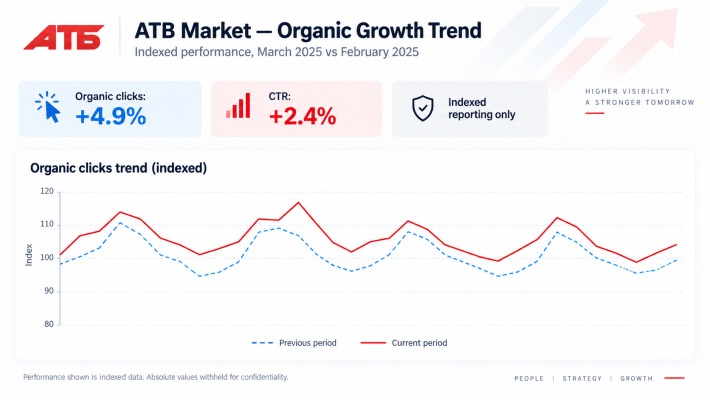
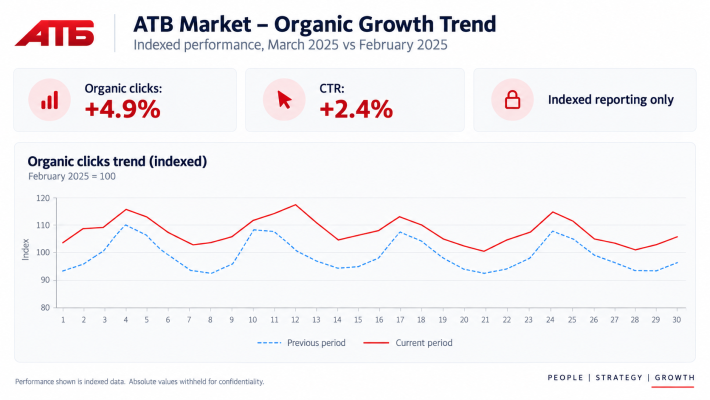
March: +4.9%
The first full month showed +4.9% organic growth.
Search impressions also increased, while CTR continued to improve.
April: +12.2%
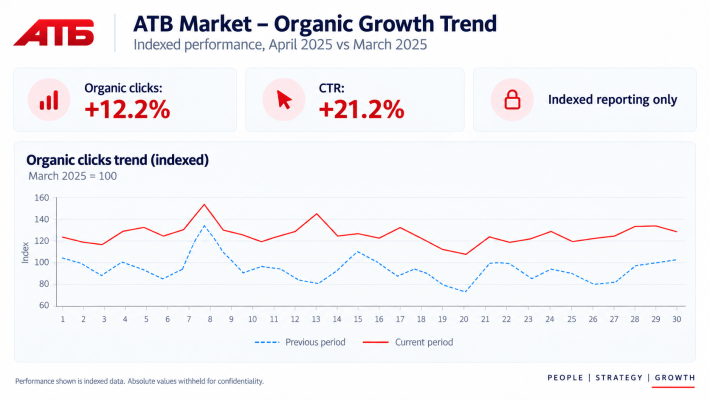
April produced the strongest month-over-month growth rate during the period:
+12.2% organic traffic
CTR also improved by more than 21% compared with the previous month.
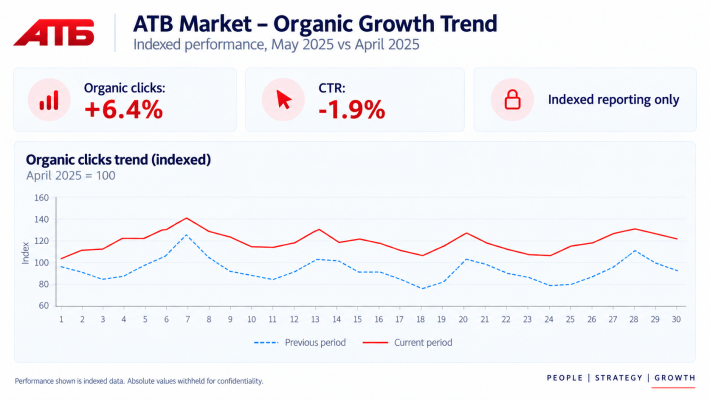
May: +6.4%
Organic traffic continued to grow:
+6.4% month over month
Search impressions increased by almost 9%, indicating broader organic coverage.
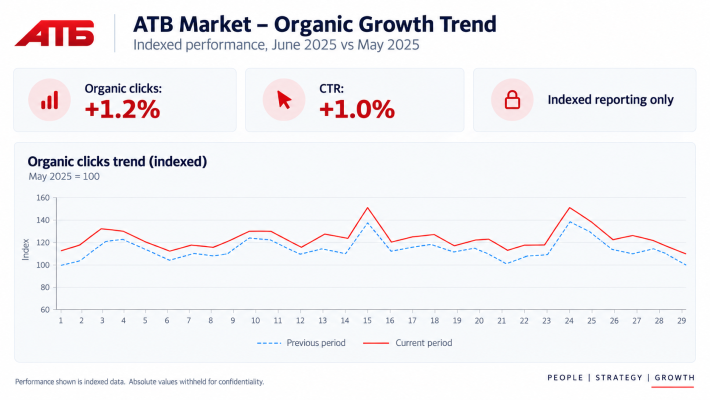
June: +1.2%
Growth continued in June despite a slower month:
+1.2% month over month
Positive dynamics remained visible across branded, Ukrainian-language, and seasonal search demand.
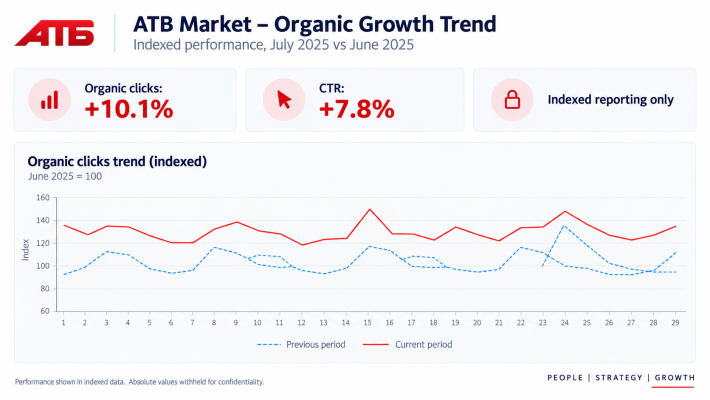
July: +10.12%
July delivered another strong increase:
+10.12% organic traffic month over month
CTR also continued to improve.
Five Consecutive Months of Growth
The month-over-month progression during the analyzed period was:
March: +4.9% April: +12.2% May: +6.4% June: +1.2% July: +10.12%
Combined, this resulted in +39.6% organic traffic growth over five months.
At the same time, organic CTR improved by approximately 32.5% compared with the starting point.
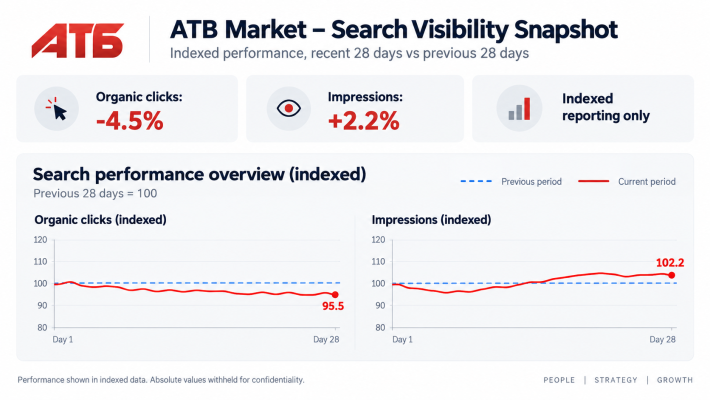
August: Stability Under External Pressure
August introduced additional external pressure.
The website experienced a significant loss of previously acquired backlinks, partly because third-party websites changed their URLs.
Google also launched the August 2025 Spam Update near the end of the month.
Despite these factors, the website maintained strong organic visibility.
Search impressions still increased by approximately 2.1%.
Multilingual Visibility Remained Stable
The Russian-language segment also remained resilient.
Search impressions increased by 4.7%, while clicks remained stable.
Non-Branded Visibility Started Expanding
Another positive signal was the appearance of additional non-branded product queries in organic search.
This was particularly important because one of the strategic objectives was to reduce reliance on historically strong branded demand.
Final Results
During the main five-month period of my involvement with the project:
Organic traffic: +39.6%
Organic CTR: approximately +32.5%
Month-over-month growth: positive for five consecutive months
Additional outcomes included:
- stronger visibility across priority queries;
- growth in non-branded product visibility;
- preservation of multilingual organic demand;
- improved technical SEO foundations;
- broader category semantics;
- a scalable content process;
- a structured link-building roadmap;
- preparation for future local SEO expansion.
Conversion, sales, revenue, absolute traffic volumes, backlink budgets, and other commercially sensitive metrics are not disclosed.
Key Takeaways
This project reinforced an important principle of large-scale SEO:
growth on an already established website rarely comes from one isolated optimization.
During my work with the project as an SEO Specialist, the strategy combined several areas:
Technical SEO created a stronger foundation.
Semantic expansion increased search coverage.
Content strengthened priority categories.
Link building supported authority growth.
Multilingual SEO helped preserve existing demand.
Local SEO architecture prepared the website for future scaling.
The most important part was consistent execution: identifying opportunities, prioritizing them, coordinating implementation, and continuously monitoring performance.
During the period I worked with the project, organic traffic increased by 39.6% over five months, while the website maintained positive month-over-month growth throughout the period.